
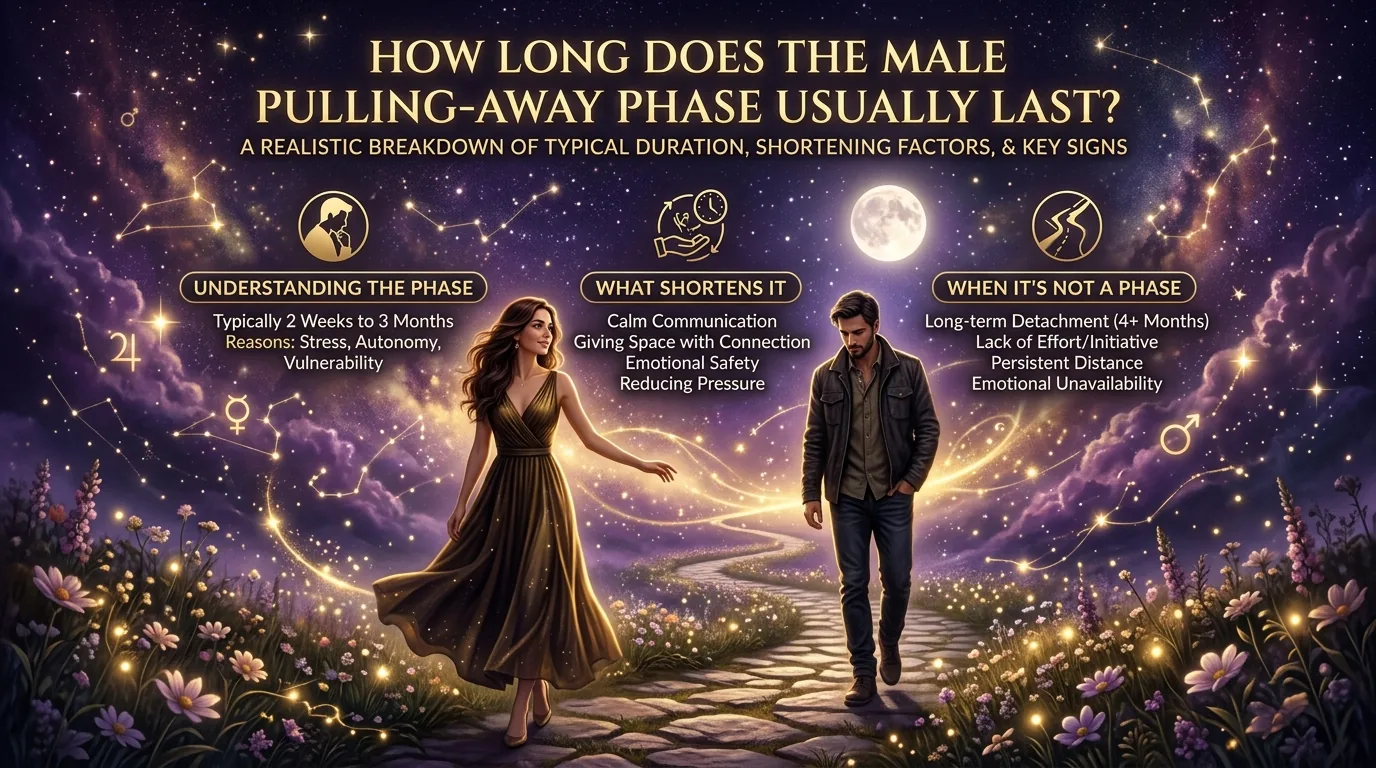
There's no single universal number, but there are real, observable patterns across different causes of male withdrawal that give a much more useful answer than a vague "it depends." Here's a realistic breakdown by cause, since the actual duration varies enormously depending on what's actually driving it.
Stress-Related Withdrawal: Typically 1 to 3 Weeks
When distance is driven by external stress — a work deadline, a family issue — it tends to resolve once the stressor itself resolves, usually within a few weeks. This type is the most predictable, since it correlates directly with an identifiable external event with its own natural endpoint.
Intimacy-Cycle Withdrawal: Typically Days to About 2 Weeks
Many men cycle between closeness and independence as a normal rhythm, especially after periods of unusually high intimacy. This version tends to be the shortest, often resolving within days to two weeks as the nervous system settles back into its normal baseline without any external intervention needed.
Avoidant Attachment Withdrawal: Typically 2 to 6 Weeks, Sometimes Longer
When withdrawal is triggered by genuine fear of closeness rather than simple need for space, it tends to last longer and can resurface repeatedly at similar intimacy milestones. This pattern often requires the withdrawing person's own self-awareness to actually shorten, more than anything a partner does externally.
Ambivalence About the Relationship: Highly Variable, Often Months
If the underlying cause is genuine uncertainty about wanting the relationship at all, the "phase" can stretch on indefinitely, since there's no natural resolution point the way there is with stress or an intimacy cycle. This is the version most likely to require a direct conversation to actually resolve rather than simply waiting it out.
Genuine Loss of Interest: Not Really a Phase at All
When distance reflects authentic, settled disinterest, it typically doesn't reverse on its own regardless of how long you wait, since there's no underlying pull back toward closeness driving a natural cycle. This is the version most often mistakenly treated as "a phase" by someone hoping it will pass.
What Actually Shortens a Genuine Temporary Phase
Giving real, calm space rather than anxious pursuit tends to shorten temporary withdrawal, since pursuit often reinforces exactly the pressure that triggered it. A single, low-pressure check-in partway through, rather than repeated contact, tends to work better than either constant contact or complete radio silence on your end.
How to Tell Which Type You're Actually Dealing With
Ask whether there's an identifiable external cause with a natural end date, whether warmth has reliably returned after past similar episodes, and whether he still shows any engagement — jealousy, curiosity, effort — underneath the distance. The combination of these answers points fairly reliably toward which category applies.
What If He's Never Pulled Away Before?
A first-time pulling-away episode in an otherwise consistent relationship deserves a slightly different read than a repeating pattern. If withdrawal is genuinely new behavior, it's more likely tied to a specific, identifiable trigger — a life event, a stressor, a milestone moment — rather than a deeper attachment pattern that's simply been dormant. In these cases, a direct, calm conversation asking what changed recently tends to surface the actual cause faster than assuming it fits one of the more established categories, since there may be a specific one-time explanation not accounted for by the general patterns above.
Is it normal for a pulling-away phase to last over a month?
It can be, particularly for avoidant attachment patterns or genuine ambivalence, but a month or more without any improvement is generally worth addressing directly rather than continuing to wait passively.
Does contacting him during the phase make it last longer?
It depends on the type and the intensity of contact — occasional, calm contact rarely extends it, while frequent, anxious pursuit often does, regardless of the underlying cause.
How do I know if it's a phase or the actual end of interest?
Look for any underlying engagement — does he still seem to care what you're doing, does jealousy or curiosity show up at all — versus complete, settled indifference, which usually signals something more final.
Should I ever just ask him directly how long this will last?
Yes, especially once a few weeks have passed. A calm, direct question about what's going on tends to produce more useful information than continued guessing from the outside.
Does the length of the relationship affect how long pulling away lasts?
Somewhat — longer, more established relationships often have more resilience and tend to resolve temporary withdrawal faster than very new relationships with less built-up trust to draw on.
Does his personality type predict how long he'll typically pull away?
Somewhat — men who tend to process things internally and privately often take longer to re-emerge than men who process out loud, regardless of the underlying cause of the withdrawal itself.
✧ Understand the Psychology of Male Withdrawal ✧
Learn the deeper emotional triggers behind male distance and how to respond to each type effectively.
Get The Free Attraction Triggers Guide