
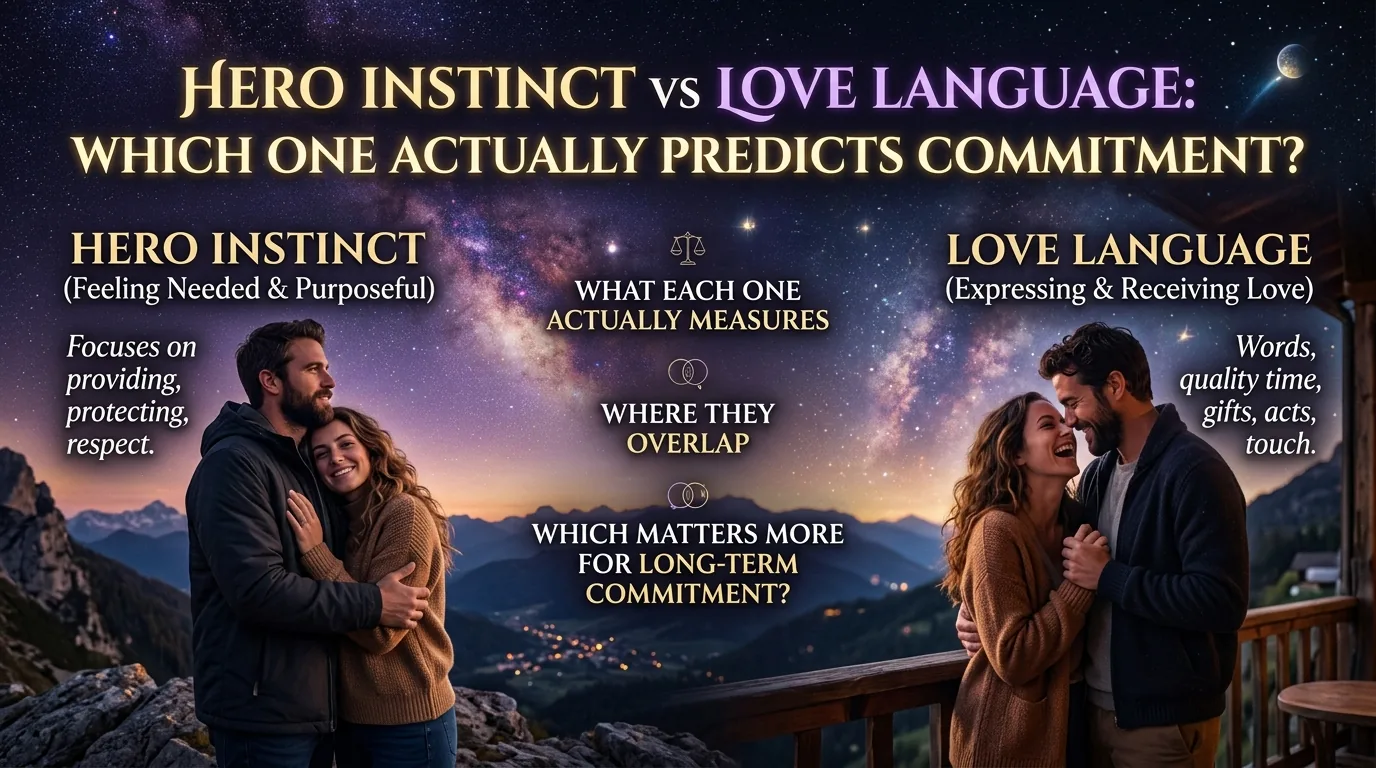
Two frameworks dominate popular relationship advice right now: the Hero Instinct, coined by relationship expert James Bauer, which describes men's drive to feel needed as a provider and protector, and Love Languages, from Dr. Gary Chapman, which describes the different ways people prefer to give and receive affection. They're often discussed separately, but understanding how they actually relate clarifies a lot of confusing advice.
What the Hero Instinct Actually Describes
The Hero Instinct is specifically about a man's need to feel genuinely useful and irreplaceable to the woman he loves — not flattery, but real, felt necessity. It's less about how affection is expressed and more about whether a man feels like his effort matters and is actually needed, which taps into something closer to purpose than romance.
What Love Languages Actually Describe
Love Languages categorize how people prefer affection to be expressed and received: words of affirmation, quality time, acts of service, physical touch, and gifts. It's a communication framework first — helping partners translate affection accurately — rather than a theory about deeper psychological drives like purpose or necessity.
Where the Two Frameworks Actually Overlap
Acts of service, one of the five love languages, overlaps significantly with the Hero Instinct, since both describe a man expressing and receiving value through being useful. This overlap explains why "letting him help you" tends to show up as effective advice across both frameworks — it satisfies a love language and activates the Hero Instinct simultaneously for many men.
Where They Genuinely Diverge
Love Languages is agnostic about gender and applies symmetrically to both partners' preferences. The Hero Instinct is specifically about a gendered psychological pattern tied to feeling needed as a protector, which doesn't map onto every man equally and isn't intended as a symmetrical framework the way Love Languages is.
Which One Actually Predicts Long-Term Commitment Better?
Love Languages predicts day-to-day relationship satisfaction more directly, since mismatched expression of affection is a common, measurable source of friction. The Hero Instinct speaks more specifically to depth of commitment and motivation to stay — a man who consistently feels needed and valued in this specific way tends to invest more deeply over time, beyond simple satisfaction with how affection is communicated.
How to Use Both Together in a Real Relationship
Identifying his primary love language tells you how to communicate affection in a way he'll actually register. Understanding the Hero Instinct tells you how to make him feel genuinely necessary, not just appreciated. Used together, one improves daily connection while the other builds the deeper motivation to stay committed long-term.
A Practical Example of Both in Action
Imagine asking him to help you decide between two job offers. Approached through Love Languages, you might frame the request based on his preferred style — asking for quality time to talk it through, or valuable, encouraging words about your capability either way. Approached through the Hero Instinct, the framing shifts slightly: you're specifically asking for his judgment because you trust it and genuinely need his perspective to feel confident deciding. The situation is identical; the psychological lever being pulled is different, and combining both — his preferred communication style, aimed at making him feel genuinely necessary — tends to produce the strongest response of all.
Can a man have acts of service as his love language without being driven by the Hero Instinct?
Yes — the frameworks describe related but distinct things. Some men prefer service-based affection without it being tied to a deeper need to feel like a protector or provider.
Is the Hero Instinct scientifically proven the way attachment theory is?
It's a popular relationship framework rather than an academically established psychological theory, though it draws on real, observable patterns in male psychology and evolutionary behavior research.
Which framework should I learn first if I'm new to relationship psychology?
Love Languages is generally easier to apply immediately in daily communication. The Hero Instinct is worth learning once you want to understand deeper, longer-term commitment dynamics specifically.
Do women have an equivalent to the Hero Instinct?
Bauer's framework focuses specifically on male psychology, though similar underlying needs — to feel valued, needed, and purposeful — exist across genders in different forms.
Should I take a love language quiz with my partner?
It can be a genuinely useful, low-pressure way to open a conversation about how you each prefer to give and receive affection, especially if you've never discussed it explicitly before.
Is one framework more useful early in a relationship versus later?
Love Languages tends to help more early on, since communication styles need establishing quickly. The Hero Instinct becomes more relevant as the relationship deepens and long-term commitment is being built.
✧ Go Deeper Into the Hero Instinct ✧
Learn the full framework behind what actually makes a man feel irreplaceable — and how to trigger that feeling authentically.
Get The Free Momentum Method Guide